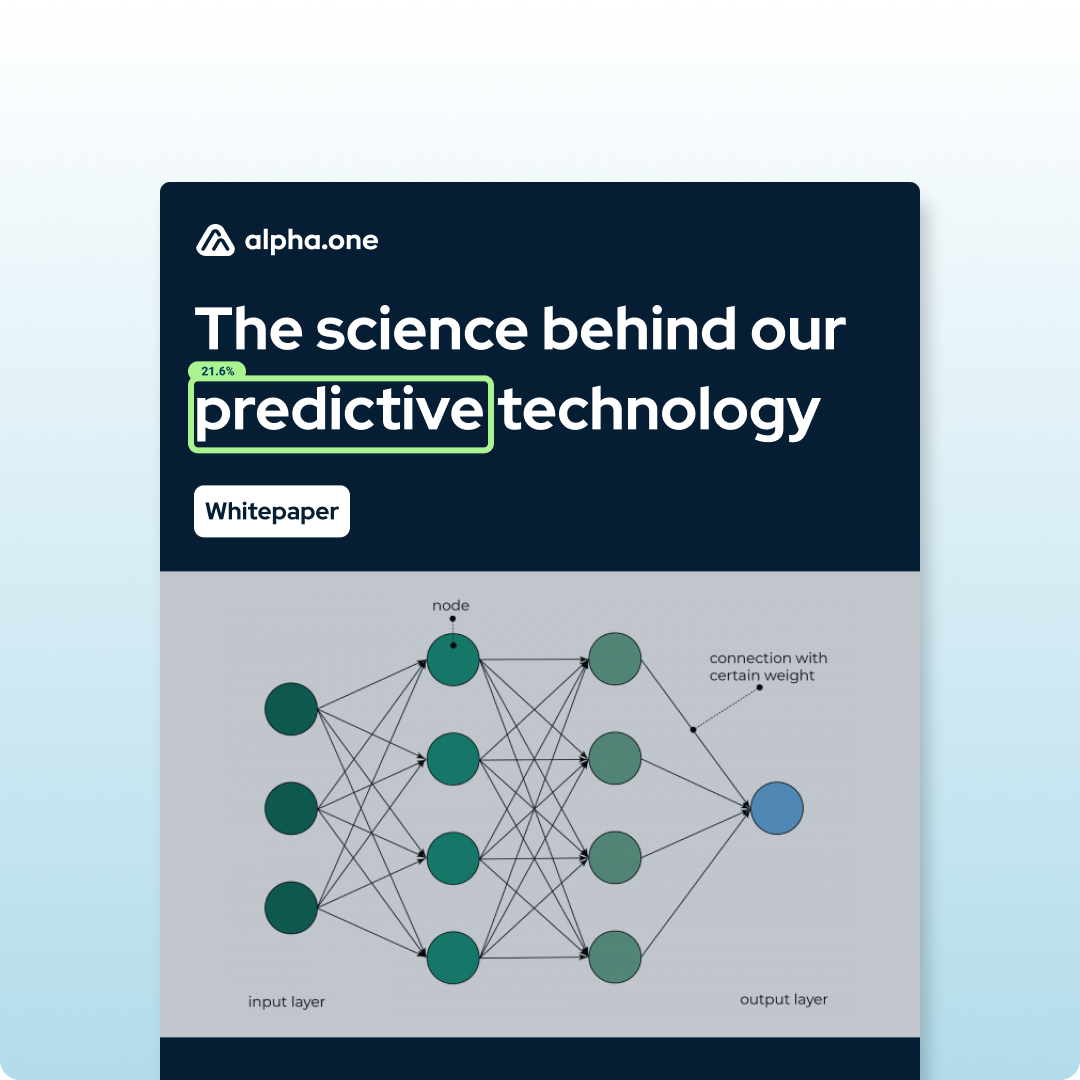
A look at the technology behind our platforms

Visualisation of an artificial neural network (ANN) on a cover page
A picture of Coert van Gemeren
Written by

Coert van Gemeren

Predict Human Attention with Algorithmic Precision

Predictive attention technology is an applied AI framework that uses artificial neural networks trained on massive human datasets to simulate eye-tracking. By analyzing visual data, it generates accurate fixation maps in seconds, eliminating the logistical constraints and personal biases of traditional eye-tracking studies.  

Traditional eye-tracking relies on small participant pools prone to localized bias. alpha.one replaces these limitations with scalable, evidence-based science. Our proprietary neural network architecture is trained on the true visual responses of thousands of people to predict what naturally draws the human eye.  

Operating entirely in a rapid online environment, our infrastructure processes static images in seconds and complete videos in minutes—delivering instant attention metrics through junbi, expoze, and the alpha.one api. (To optimize your creative structure further, read our guide on measuring Visual Complexity).  

Validated Against the MIT Saliency Benchmark

The data confirms our accuracy. Validated against the gold-standard MIT Saliency Benchmark using similarity scoring (SIM) and Area Under the Curve (AUC), our technology consistently outperforms standard competitive models and single-human panels.

Unlock the complete mathematical models, precision curves, and deeper verification data behind our attention infrastructure below.

Related Insights
First-person POV looking straight down from the edge of a high-rise building at night, showing sneakers dangling over illuminated city streets and surrounding skyscrapers.

From Eyes to Hands: Escaping the Observer Trap with First-Person Framing and Gaze Cueing

Bypass the "Observer Trap" by combining gaze cueing and first-person framing to direct attention and turn passive viewing into active participation.

READ MORE
An extremely cluttered room and desk overflowing with stacked papers, cardboard boxes, certificates, framed photos, and dense visual noise.

The Hidden Cost of Visual Clutter: Why Your Brain Loves Lazy Design and Familiarity

Visual clutter acts as a cognitive tax that drains working memory. Learn how cognitive load theory and familiarity drive user trust and better UI design.

READ MORE
A conceptual, textural graph showing a declining curve of fuzzy balls over smaller figures, shifting color from orange to pink to purple on a light backdrop.

From Attention to Retention: The Science Behind Retention and Why Getting Noticed is Not Enough

Getting noticed isn't enough. Discover the science of ad retention, why the 3-second threshold matters, and how to optimize for maximum sales lift.

READ MORE

Subscribe to our monthly newsletter.

Stay ahead of the competition with a monthly summary of our top articles and new scientific research.